


Irries "Uni Fusion" Belt
Irries "Uni Fusion" Belt
At-home therapy device combining four clinical therapies to relieve sciatica & back pain.
- Complete spinal restoration therapy
- Doctor approved, backed by 30+ studies
- Save $1950+/week on clinic visits
- 60-day money-back guarantee
$119.99
$249.99Save $130- Save $130
- Free Worldwide Shipping
- Free Extension Strap (fits up to 53")
- 60-Day Money-Back Guarantee
FREE GIFTS — ARRIVES WITH YOUR ORDER
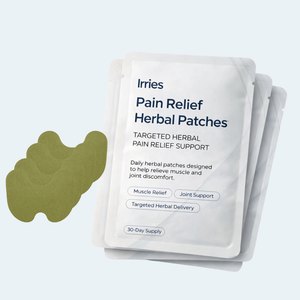
$34.99
Sciatica Relief Patches
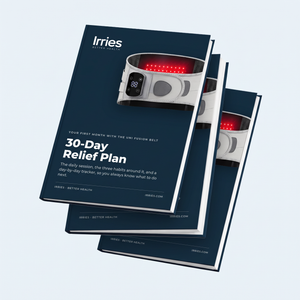
$24.99
30-Day Relief Plan
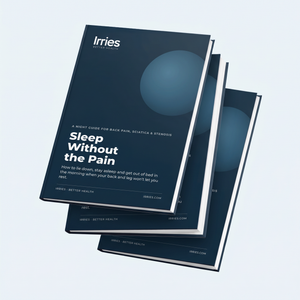
$24.99
Sleep Without the Pain
$19.99
1-Year Warranty
Couldn't load pickup availability
- Amazon pay payment method
- American express payment method
- Apple pay payment method
- Diners club payment method
- Discover payment method
- Google pay payment method
- Master payment method
- Paypal payment method
- Shopify pay payment method
- Usdc payment method
- Visa payment method
Backed by Experts
“Back pain & sciatica treatment has always only managed symptoms. This belt goes after the reason behind the pain — a starving disc. It combines four clinical therapies to drive blood flow to the disc so it can heal. And my patients have had amazing results."
 Dr. Blane Schilling, MD — 36 Years in Back & Spine Care
What's Included
What's Included
- Irries Uni Fusion Belt — the 4-in-1 therapy device
- Sciatica Relief Herbal Patches — targeted herbal support between sessions
- USB-C Charging Cable
- 30-Day Relief Plan eBook — your first month with the belt, day by day
- Sleep Without the Pain eBook — how to lie down, sleep and get up with less pain
- 1-Year Warranty — covered against defects for a full year
- 60-Day Money-Back Guarantee — wear it for two months risk-free
How It Works
How It Works
Four therapies work together in one device, applied across your lower back at the same time.
A session takes about 20 minutes.
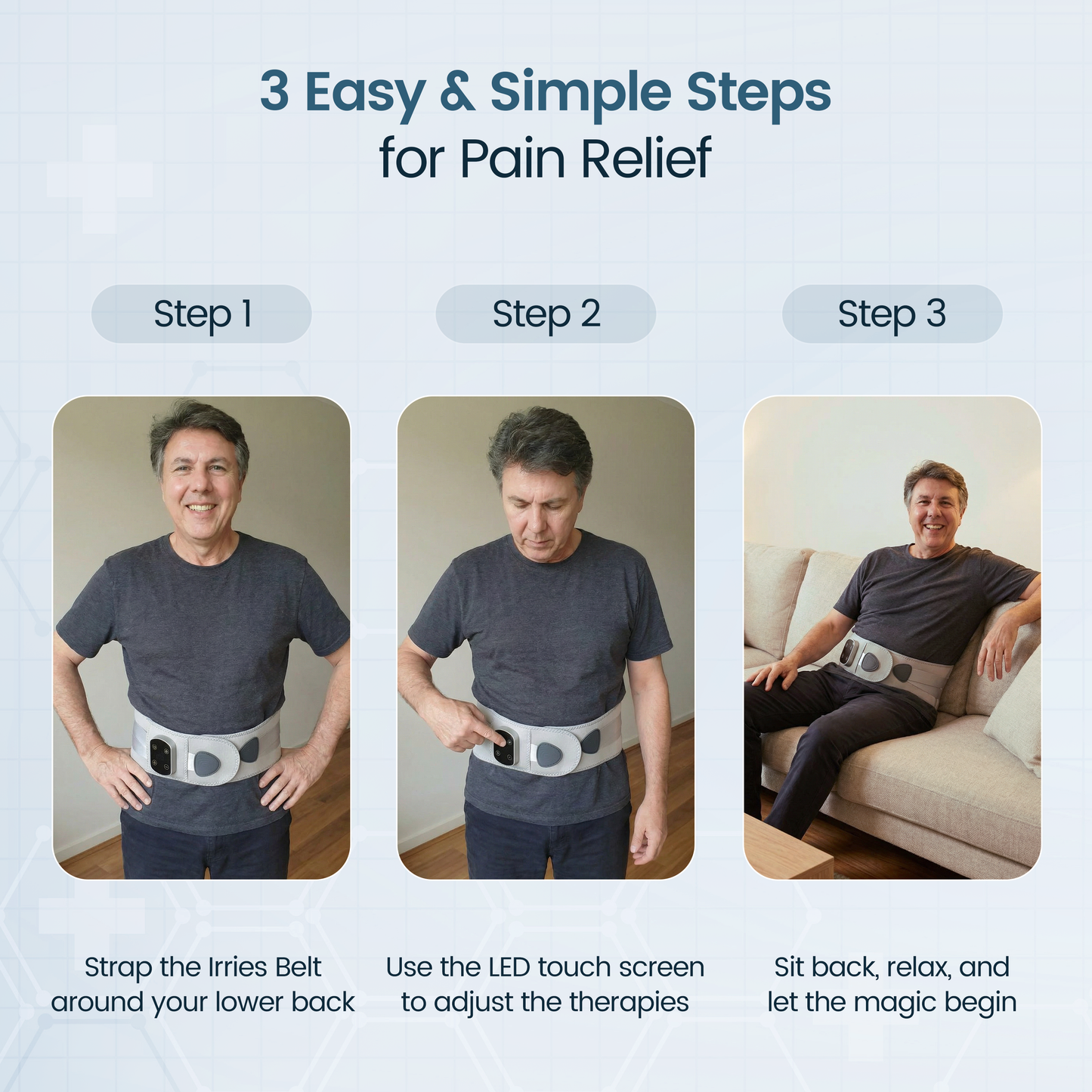
- Position the belt so the light panels sit centred on your lower back.
- Wrap the main belt around your waist and secure the closure at the front.
- Pull both side tension straps to a firm but comfortable tightness.
- Hold the power button for 3 seconds to switch on.
- Tap the heat and vibration icons to set your levels.
Most people run one to two sessions a day.
60-Day Money-Back Guarantee
60-Day Money-Back Guarantee
All orders are backed by our 60-Day Results or Money-Back Guarantee.
That means that if you tried our device but didn't experience the results you were looking for, contact us at support@irries.com and we'll send you your money-back.
Shipping & Delivery
Shipping & Delivery
We proudly ship worldwide and every order of the Irries Uni Fusion belt comes with free worldwide shipping (tracked).
Orders are processed within 1–3 business days and once your order ships you'll receive an email from support@irries.com.
We offer Express Shipping as an additional charge at checkout.
Full Specifications
Full Specifications
Therapies
- Mechanical decompression — internal spine support rods with adjustable compression
- Heat therapy — 3 temperature levels
- Red & near-infrared light therapy — LED array
- Massage therapy — 3 vibration intensities
Fit
- Waist 28"–45" (70–115 cm)
- Up to approx. 53" (135 cm) with the included extension strap
Power & battery
- 5000 mAh internal lithium-ion (not user-replaceable)
- USB Type-C charging, from any standard 5V adapter
- Charge time 2.5–3 hours from empty
- Runtime 60–90 minutes with all therapies running; up to 24 hours massage-only
Use
- Session length 15–30 minutes (20 minutes typical)
- Up to two or three sessions per day
- Touch controls with double-tap screen lock
- Automatic shut-off at the end of every session
In the box
- Uni Fusion Belt, USB-C charging cable, extension strap and user guide
Not Available on Amazon or eBay
Not Available on Amazon or eBay
Irries is sold only through irries.com — never on Amazon, eBay or any other marketplace.
- Listings elsewhere are not ours and are cheap counterfeits. We can't verify what's in the box or how it has been handled.
- Your 1-Year Warranty and 60-Day Money-Back Guarantee apply only to orders placed here.
For original Irries devices with our clinical-grade technology, shop only at "irries.com".
If you've seen an Irries listing on a marketplace, email support@irries.com and we'll look into it.


It works on what's causing the pain.
Your disc is pressing on the nerve and can't heal because it doesn't get any blood flow. Everything below comes from fixing that one thing.
Decompression opens the space around the disc so it stops pressing.
The one thing nothing you've tried has done — and what the disc needs to heal.
Red and near-infrared light settle the tissue that's been blocking recovery.
Stops the surrounding muscle re-compressing everything between sessions.
Less pressure on the nerve is less pain down your leg.
The things that hurt most are usually the first to get easier.
Four clinical therapies, engineered into one device.
Each one is a treatment a clinic already charges for. Run together, in sequence, they do what none of them can do alone.
Mechanical Decompression
Built-in spine support rods and targeted compression gently stretch the vertebrae apart. That decompression opens up space around the disc — allowing for blood to flow in.
Heat Therapy
Clinical-grade thermotherapy (heat) warms deep into the lower back and triggers vasodilation — the blood vessels widen and flood nutrient-rich blood to the starving disc.
Red & Near-Infrared Light Therapy
A dual-wavelength LED panel runs both therapies. Red light at 660nm triggers cellular repair at the surface. Near-infrared light at 850nm penetrates far deeper — clearing the inflammation around the disc that blocks blood flow.
Vibration Massage Therapy
Three intensity settings of targeted vibration work into the erector spinae — the thick muscle columns either side of your spine that grip the lower back and won't let go. It releases the deep tightness and tension.
Four therapies. Four clinics. One device.
Each therapy in the belt is one a clinic already charges for — and they're four different clinics. The belt runs all four in one 20-minute session at home.
Based on typical US clinic rates. Your own costs will vary.
Clinically Studied. Less Pain. More Movement.
When proven therapies are combined in one device, the results speak for themselves.
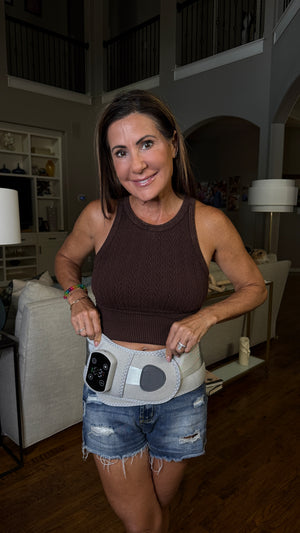
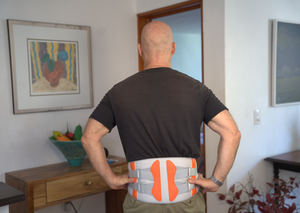
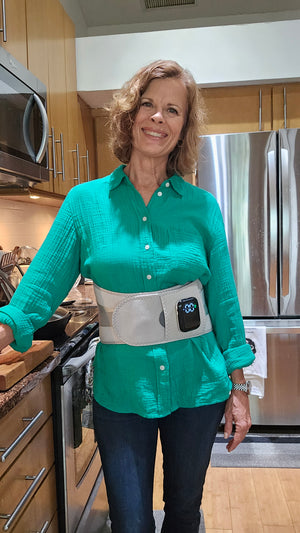
Real Stories, Real Results
Our reviews are our motivation. We couldn't be prouder to see how much our technology is helping others.
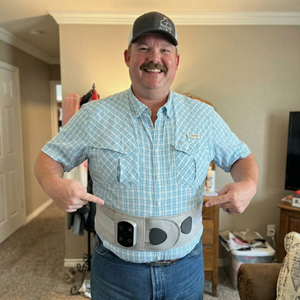
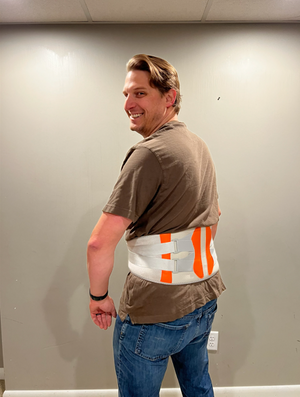
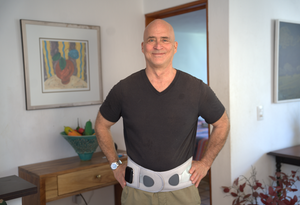
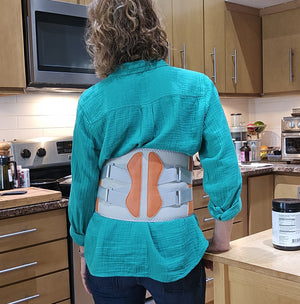
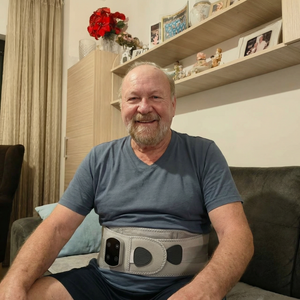
What to expect. Your 12-week road back.
20 minutes a day. Blood flow builds on itself — every session does a little more than the last. Here's how it usually unfolds.
Based on how the four therapies work and what customers report. Individual results vary.
- Relief you can feel from your very first sessions*
- The muscle gripping your lower back finally lets go*
- Sitting stops being the worst part of your day*
- Inflammation settles and more blood reaches the disc*
- You wake up looser — mornings stop being a battle*
- You're on your feet longer, doing more of what you'd stopped*
- More good days than bad, and the bad ones pass quicker*
- Studies show a disc with blood flow can retract off the nerve on its own*
- You stop planning your day around the pain*
- Three to five sessions a week keeps you there*
- Flare-ups get rarer, shorter and easier to shake off*
- The belt becomes part of your routine, not your rescue*
Not sure it'll work for you?
Compared with what else is out there
Most options work on the pain. This one works on the disc that's causing it.


Try it for 60 days
Wear it for 60 days. If your back doesn't feel better, send it back — the full terms are in the guarantee section above.
Thousands Of Happy Customers
Irries has treated over 12,000+ backs and the success stories are endless.
Frequently asked questions
How quickly will I feel relief?
How quickly will I feel relief?
Many users feel noticeably less pain, tension, and stiffness after just one session — especially if your pain is caused by poor posture or muscle strain. The Irries Belt’s "Uni Fusion" technology working immediately, and results compound with daily use. Most people report major relief within 3–5 days, and life-changing results in 1–3 weeks.
Is it comfortable to wear? Can I still move normally?
Is it comfortable to wear? Can I still move normally?
Absolutely. Unlike bulky braces that restrict your movement, the Irries Belt is made with spine support rods and focus compression that stabilize your spine without locking you in place. You can still bend, twist, and walk freely — just with far less strain and pain.
I’ve tried chiropractors, painkillers, and nothing works. Will this really help?
I’ve tried chiropractors, painkillers, and nothing works. Will this really help?
We hear this all the time. Unlike treatments that just offer temporary relief, the Irries Belt combines structural support, posture retraining, and cellular-level therapy (like Heat and BiWave Light Therapy) to actually fix the problem. Many users who had “tried everything” say the Irries Belt has finally gave them lasting relief.
Is it rechargeable & easy to use?
Is it rechargeable & easy to use?
Yes! The Irries Belt is completely wireless and rechargeable with a USB-C cable (that's included in the order). Its easy to turn on & adjust the settings!
Can I use it if I had surgery, spinal fusions, etc.?
Can I use it if I had surgery, spinal fusions, etc.?
Yes! Many people who’ve had back surgery or spinal fusions use the Irries Belt. As long as your incision is fully healed it’s perfectly safe to wear.
Is it fully adjustable?
Is it fully adjustable?
The Irries Belt comes with a free extension strap with every order so that it can fit waists up to 53 inches.
It is fully adjustable no matter your height or weight for a snug, secure & comfortable fit!
Do you sell on Amazon?
Do you sell on Amazon?
To keep prices fair and avoid marketplace markups, we only sell directly through our official website.
Important Notice:
Please be aware that while some companies offer products that look similar to our pain-recovery devices, they are not affiliated with us. You may come across imitation listings on other websites, which can be misleading.
We, Irries, own the trademark on our devices and are the only authorized sellers. Purchasing from unauthorized sources is at your own risk — we cannot ensure the quality, authenticity, or support for products sold elsewhere. Even if they appear similar, off-brand pain recovery devices will likely differ in performance and safety.
Where do you ship to?
Where do you ship to?
We proudly ship worldwide, so no matter where you are, you can have our best-sellers shipped right to your front door!
How can I track my order?
How can I track my order?
If you'd like to check the status of your order, go here
Four therapies. Every one studied.
Every therapy in the belt is an established treatment with published research behind it. Here is that research, with links — read it yourself.
Mechanical Decompression
Traction and decompression are studied for one reason: taking mechanical load off the lumbar spine opens the space around a herniated disc. Trials in sciatica specifically report reduced radicular pain, and imaging studies show measurable changes in disc height under axial traction.
8 studies · traction, decompression and lumbar support- Lumbar traction in radicular pain caused by herniated disc — randomised controlled trial, 424 patients — Journal of Clinical Medicine, 2025
- High-force versus low-force lumbar traction in acute lumbar sciatica due to disc herniation — J. Manipulative & Physiological Therapeutics, 2016
- Non-surgical decompression therapy added to physical therapy in lumbar radiculopathy — BMC Musculoskeletal Disorders, 2022
- Regression of lumbar disc herniation by physiotherapy: does non-surgical spinal decompression make a difference? — J. Back & Musculoskeletal Rehabilitation, 2017
- Effectiveness of lumbar traction with routine conservative treatment in acute herniated disc syndrome — J. of the Medical Association of Thailand, 2004
- Changes in spinal height after manual axial traction — a clinical measure of disc hydration — J. Manipulative & Physiological Therapeutics, 2019
- Lumbar bracing for chronic low back pain: a randomized controlled trial — American J. of Physical Medicine & Rehabilitation, 2021
- Lumbar braces and other assistive devices for chronic low back pain — Cochrane Database of Systematic Reviews, 2024
Heat Therapy
Continuous low-level heat is one of the most trial-tested treatments in all of low back pain — including a head-to-head trial where it outperformed ibuprofen and acetaminophen. Separate physiology work shows why: local heating opens the blood vessels and raises blood flow through the warmed tissue.
9 studies · heat wrap trials and the blood-flow physiology behind them- Continuous low-level heat wrap therapy provides more efficacy than ibuprofen and acetaminophen for acute low back pain — Spine, 2002
- Continuous low-level heatwrap therapy for treating acute non-specific low back pain — Archives of Physical Medicine & Rehabilitation, 2003
- Overnight use of continuous low-level heatwrap therapy for relief of low back pain — Archives of Physical Medicine & Rehabilitation, 2003
- Treating acute low back pain with continuous low-level heat wrap therapy and/or exercise — The Spine Journal, 2005
- Impact of continuous low-level heatwrap therapy in acute low back pain: subjective and objective measurements — The Clinical Journal of Pain, 2007
- Effects of supplemental heat therapy on strength and flexibility in chronic low back pain — Clinical Biomechanics, 2018
- Continuous low-level heat wrap therapy for prevention and early treatment of delayed-onset muscle soreness of the low back — Archives of Physical Medicine & Rehabilitation, 2006
- Regional thermal hyperemia in the human leg — how local heat raises blood flow — Physiological Reports, 2021
- The vascular response to acute heating in young and middle-aged adults — J. of Applied Physiology, 2024
Red & Near-Infrared Light
Red and near-infrared light are absorbed by the mitochondria in your cells, which is the mechanism behind the anti-inflammatory and repair effects seen in the lab. The clinical picture in back pain is genuinely mixed — meta-analyses report pain reduction, one systematic review found no benefit over placebo. Both are listed below.
7 studies · including one that found no benefit, listed for honesty- Efficacy of low-level laser therapy: systematic review and meta-analysis of randomised placebo-controlled trials — The Lancet, 2009
- Low-level laser therapy for chronic non-specific low back pain: meta-analysis of randomised controlled trials — Acupuncture in Medicine (BMJ), 2016
- LED photobiomodulation therapy for non-specific low back pain: double-blind randomised trial — Medicine, 2020
- Low-level laser therapy for non-specific low back pain — Cochrane Database of Systematic Reviews, 2008
- Mechanisms and mitochondrial redox signalling in photobiomodulation — Photochemistry & Photobiology, 2018
- Photobiomodulation before an eccentric fatigue protocol: control of pain and muscle damage markers — Photobiomodulation, Photomedicine & Laser Surgery, 2020
- Photobiomodulation therapy does not decrease pain and disability in non-specific low back pain — J. of Physiotherapy, 2020
Vibration Massage
Vibration and massage are studied as the same thing from two directions: mechanical input to the muscle around the spine. Meta-analyses of both report reduced pain and improved function in chronic low back pain, and the Cochrane review found benefits lasting well past the treatment period.
8 studies · vibration and massage trials, meta-analyses and Cochrane reviews- Vibration therapy to improve pain and function in chronic low back pain: systematic review and meta-analysis — J. of Orthopaedic Surgery & Research, 2023
- Whole-body vibration exercise for non-specific chronic low back pain: assessor-blind randomised controlled trial — Clinical Rehabilitation, 2019
- Effects of whole-body vibration therapy on main outcome measures for chronic non-specific low back pain — J. of Rehabilitation Medicine, 2011
- Efficacy of whole-body vibration therapy on pain and functional ability in non-specific low back pain — BMC Complementary Medicine & Therapies, 2020
- Massage for low-back pain — Cochrane Database of Systematic Reviews, 2015
- A comparison of two types of massage and usual care for chronic low back pain: randomised controlled trial — Annals of Internal Medicine, 2011
- The effectiveness of massage therapy for non-specific low back pain: a systematic review of systematic reviews — International J. of General Medicine, 2013
- Recovery benefit on skin blood flow using vibrating rollers after muscle fatigue — Int. J. of Environmental Research & Public Health, 2020
Why Blood Flow Is the Whole Point
The disc is the only structure here with almost no blood supply of its own — it is fed by diffusion, and when that supply drops the disc degenerates. This is also why a herniated disc can shrink back on its own: reviews of serial imaging find spontaneous resorption in roughly two-thirds of cases.
6 studies · disc nutrition and spontaneous resorption- Nutrition of the intervertebral disc — Spine, 2004
- Factors regulating viable cell density in the intervertebral disc: blood supply in relation to disc height — J. of Anatomy, 2013
- Incidence of spontaneous resorption of lumbar disc herniation: a meta-analysis — Pain Physician, 2017
- The probability of spontaneous regression of lumbar herniated disc: a systematic review — Clinical Rehabilitation, 2015
- Predictive factors for spontaneous regression in lumbar disc herniation: systematic review and meta-analysis — J. of Neurosurgery: Spine, 2023
- Macrophage-related cytokine expression in lumbar disc herniations: a systematic review — European Spine Journal, 2020